
-
Synthetic imagery for the 3 Dec 2013 fog/low cloud case
The previous blog entry discussed CIRA satellite imagery that can be useful in highlighting fog and low clouds. These images utilize existing satellite imagery to create images that try to replicate those that will be available in the GOES-R era. Another method to create GOES-R type imagery is to use output from a high-resolution model (in this case NSSL’s 4-km WRF-ARW model run at 0000 UTC) to create “synthetic” satellite imagery. An advantage to synthetic imagery is the ability to replicate many of the bands that will be on GOES-R. We also replicate satellite imagery that forecasters currently use, such…
-
Widespread Fog East of the Rockies – 3 Dec 2013
Widespread fog and low clouds covered much of the nation east of the Rockies 0n the morning of 3 Dec in the moist airmass ahead of the developing western storm and strong cold front that has since pushed south. Dense Fog Advisories were issued by many WFOs, as seen in the graphic below valid at 1324 UTC on 3 Dec. The surface weather map at 1300 UTC on 3 Dec is shown below. A complex storm system is taking shape in the Rockies while an Arctic high pushes cold air southward into the Northern Plains. A closer look at the…
-
October 17, 2012 fog over Wisconsin
Let’s examine the synthetic low cloud / fog product from the 4-km NSSL WRF-ARW model. This is from the 0000 UTC 17 October run valid between 0900-1600 UTC 17 October: http://rammb.cira.colostate.edu/templates/loop_directory.asp?data_folder=training/visit/loops/17oct12_syn_fog&image_width=1020&image_height=900 Low cloud / fog is depicted as blue in this color table, with mid- to high level clouds being black / dark grey. Early in the loop, note the region of blue (low cloud / fog) in northern Wisconsin. As the loop progresses, this region quickly becomes obscured by mid- to high level clouds that are moving eastward. It’s unclear when this low cloud / fog is forecast to…
-
Synthetic low cloud / fog imagery to forecast stratus
The synthetic low cloud / fog product from the NSSL WRF-ARW model has a variety of forecasting applications. One of those is forecasting the development of stratus clouds. The NWS forecast office in Austin / San Antonio made use of this product for the above mentioned application on September 23: AREA FORECAST DISCUSSION NATIONAL WEATHER SERVICE AUSTIN/SAN ANTONIO TX 626 PM CDT SUN SEP 23 2012 … AVIATION… CONVECTION ALONG THE SEA-BREEZE BOUNDARY WILL REMAIN SOUTH OF KSSF AND KSAT AND WILL DISSIPATE AFTER SUNSET WITH THE LOSS OF DAYTIME HEATING. OTHERWISE THE CU FIELD THIS AFTERNOON IS AN INDICATION…
-
Synthetic Satellite Imagery evaluated at SPC
As part of NOAA’s Hazardous Weather Testbed Spring Experiment at the Storm Prediction Center, CIRA is delivering 3 synthetic imagery products to be evaluated in the Experimental Warning Portion of the experiment in their AWIPS-II system: 6.95 micrometers, 10.35 micrometers, and the 10.35 – 12.3 micrometer difference product. Chris Siewert is hosting a separate blog and regularly adding posts with details on how the products are being evaluated. Those entries can be found here: http://goesrhwt.blogspot.com/search/label/Simulated%20Satellite%20Imagery
-
ORI product for 18-20 December 2010 massive California rain event
A period of extremely heavy rain and massive higher elevation snow hit California and other portions of the West during mid-December 2010. Here we take a look at the ORI product for a portion of this storm, concentrating on Central and then Southern California. The ORI (for Orographic Rain Index) product is designed to indicate to forecasters where there is short-term (0-3 hours) potential for heavy orographic rain. The product has a horizontal resolution of approximately 1 km. Three data sources are used to create the ORI product: The CIRA TPW product is derived from water vapor measurements from various…
-
Low cloud/fog example from Boulder WFO case from AWIPS on 9 December 2010
GeoColor and Low cloud/Fog GOES-R Proving Ground imagery from CIRA has been available at the Boulder WFO for several years. After feedback from the forecasters, recently GeoColor imagery without the city lights was added. This example shows both types of GeoColor imagery along with the Low Cloud/Fog product for a case of expanding low clouds and fog that eventually moved over the Denver International Airport (DIA) during the night into the early morning hours of 9 December 2010. Images for several different times, with comments, are shown below.
-
Cloud over snow example on 30 November 2011 from Buffalo WFO using MODIS imagery
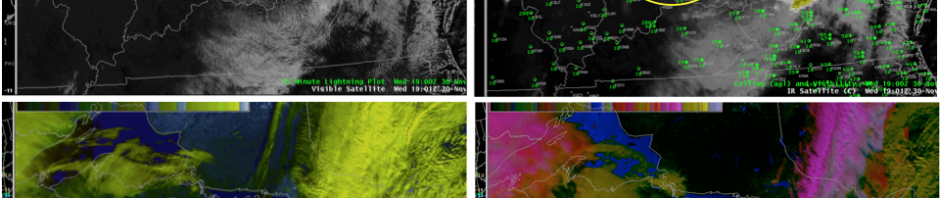
Buffalo WFO SOO David Zaff collected this imagery from one of the forecasters, Robert Hamilton, who sent him the following message: “I found it very interesting to see snow cover on the basic IR imagery late this afternoon, so I have attached both the IR and VIS imagery from 19z. ‘Sampling’ over the snow cover on the IR imagery, I was getting consistent temps of -2 to -3c, and when I moved off the snow cover to the dry land, I was getting readings of +2 to +3c. After showing Paone (another forecaster), he went into the MODIS imagery and noted how well it was shown in both the Cloud/Snow Discriminator image…
-
Synthetic IR imagery showing fog/low clouds from BOU WFO on 8 November 2011

This example from the Boulder WFO shows the use of synthetic IR imagery generated from the 4-km horizontal grid resolution NSSL WRF model for predicting an area of fog and low clouds near the Denver International Airport (DIA) on the morning of 8 November 2011. The WRF model is run daily at 0000 UTC, and the ultimate purpose of the synthetic imagery is to use it to replicate realistic-looking imagery that represents some of the new GOES-R channels. Building forecaster confidence in using this new type of output from a numerical model as well as the ability of the model…
-
Synthetic Fog Product – November 19/20, 2011 example
This blog entry will look at an example of the synthetic fog product (from the 4-km NSSL WRF-ARW model) for an event that took place during the overnight hours of November 19 to 20, 2011. Here is the synthetic fog product during the overnight hours: http://rammb.cira.colostate.edu/templates/loop_directory.asp?data_folder=training/visit/loops/19nov11_syn_fog There is southerly flow advecting moisture from the Gulf of Mexico northward. The increasing moisture, in combination with nighttime cooling leads to the development of a large area of stratus clouds across the Plains from Texas to Nebraska and eastward across the southeast states. This enhancement will depict regions of low-level clouds in the…
Recent Posts
Recent Comments
People are concerned about snowboarding when they should be worried about the water supply in general. We’re using it an…
An excellent and very thorough analysis of this high-impact blowing dust event. Additional satellite images (including GOES visible animations) are…
I’ve been looking at DNB (and brightness temperature difference) over the PAC NW the past couple days: https://fusedfog.ssec.wisc.edu/?p=886 Great time…
Ed, Yes, I had noticed this the other day also…good that you caught it and posted! These dust events over…
Excellent analysis of this event. As a supplement, we have GOES-15 and Himawari-8 water vapor imagery of the storm posted…